Case Study
Building the new Firefox.com
Mozilla needed a publishing platform to support an ambitious brand overhaul for Firefox. Lincoln Loop met the challenge with a highly-composable, multilingual Wagtail CMS and robust frontend component library.
Background
Mozilla is the non-profit behind Firefox, one of the world's most popular open-source web browsers. With millions of users worldwide and a mission to keep the internet open and accessible, Mozilla operates at global scale across dozens of languages. Its website introduces new users to Firefox, delivers browser downloads, and communicates updates to a global audience of tens of millions of weekly visitors.
When the Firefox brand underwent a major visual update, Mozilla needed a publishing platform that could reduce workflow bottlenecks and empower multiple teams to meet demanding content goals.
Challenge
The existing publishing workflow was over-reliant on technical staff. The marketing team compiled content, passed them to the web development team to build in HTML, who then handed the finished pages to the internationalization team for translation. The process was labor-intensive and introduced recurring bottlenecks. Mozilla needed a system that could streamline this workflow while supporting global localization and high-traffic publishing.
Several factors made the replatform particularly complex:
- High-volume release publishing: Firefox ships major updates every six weeks. After each update, millions of users are directed to a “What’s New in Firefox” page explaining the latest features. Within days of a release, these pages can reach more than 60 million users across five languages.
- Legacy browser support: Because firefox.com is where users download the browser itself, the site needed to remain functional on Internet Explorer and legacy versions of Safari.
- Mixed content model: The site would launch with a combination of legacy static pages and CMS-driven content. A well-documented component library was critical to seamlessly bridging both environments.
- Platform-aware content: Certain high-visibility pages needed to serve completely different content depending on operating system, browser version, logged-in status, and various browser user preferences. These things were trivial to detect when the site was built with static HTML, but building these conditions into the CMS introduced UX and editorial challenges.
Client


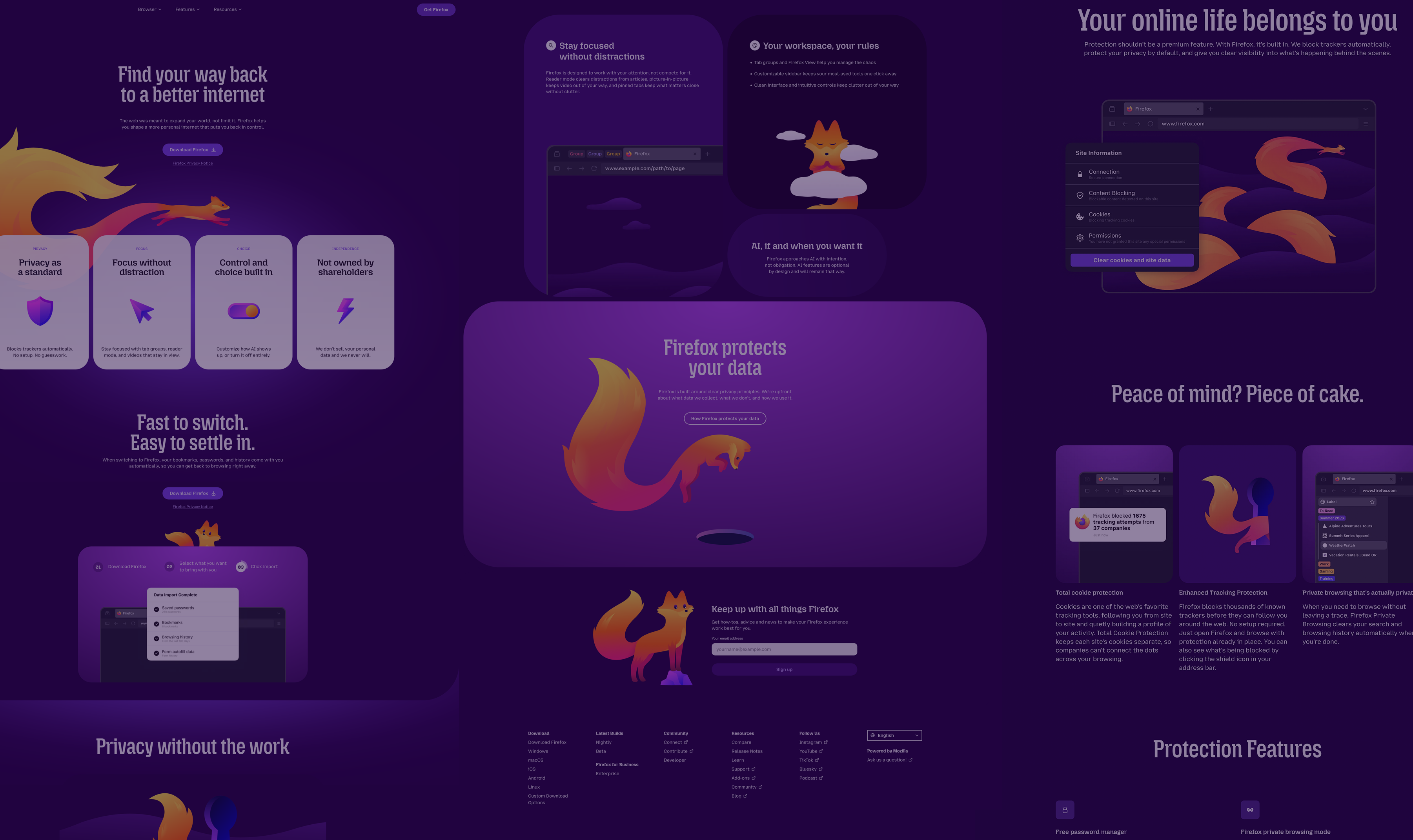
The new CMS allows for rich storytelling and seamless integration with Mozilla's third-party translation provider.
Solution
The team approached the project in stages, beginning with the high-traffic "What’s New in Firefox" release cycle pages.
We built a suite of Wagtail CMS components that empower the Firefox marketing team to build and publish these pages independently. The new workflow also allows marketing to submit English content for translation directly within the CMS, further reducing manual hand-offs and streamlining the localization process. The result is a content pipeline that allows each team to focus on the things they care about.
With the release-cycle workflow in place, we began expanding the system to support the broader redesign. While working closely with Mozilla's designers and developers, we built a robust, accessible component library based on the (beautiful!) new brand designs that were created in partnership with UpStatement. The component library was designed to work in both CMS-driven and static page contexts, a deliberate choice given the phased migration plan. Well-documented components mean legacy pages can adopt the new design immediately and be safely ported into the CMS over time.
To handle platform diversity, we built context-aware utility layers into the CMS. Certain mission-critical pages serve completely different content based on a variety of user metrics. For older browsers, we also implemented a "legacy browser mode" that delivers a functional, accessible experience to visitors on Internet Explorer and outdated versions of Safari. By simplifying the presentation for these environments, Mozilla can confidently adopt modern browser capabilities for the primary experience while keeping critical paths in-tact for older technology.
The Right Fit for the Job
Mozilla needed a partner who could move fast without cutting corners. The project required tight coordination across multiple internal teams and timezones, all against a firm, public launch deadline tied to the brand refresh. Lincoln Loop offered deep experience with Django, Wagtail, goal-oriented CMS architecture, and large-scale content platforms. Our familiarity with multilingual workflows, Design Systems, and large-scale CMS migrations allowed us to move quickly while architecting a system built for both the imminent launch and Mozilla’s future goals.
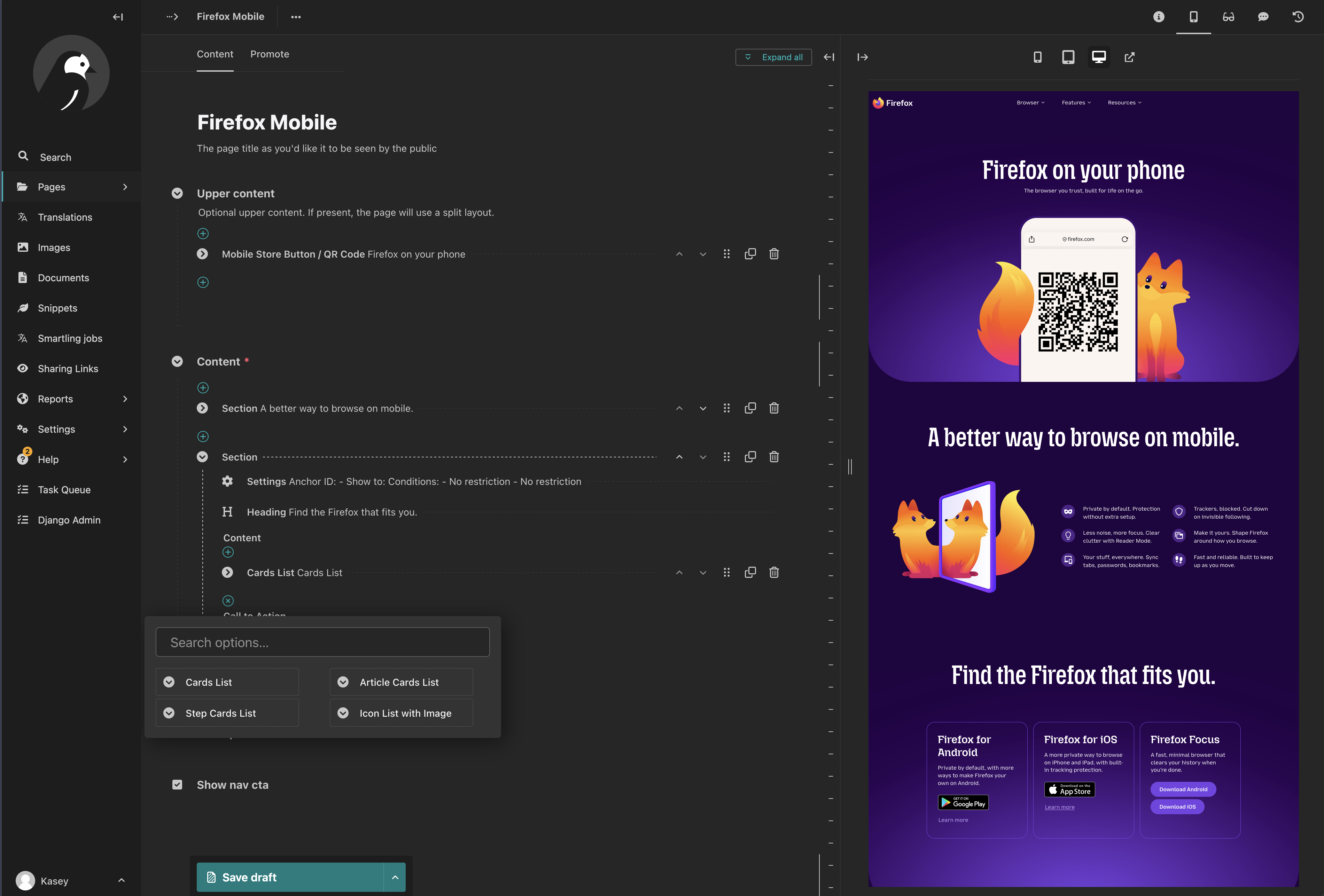
Wagtail CMS provides authors with the perfect balance of contextual control and flexibility when building pages.
Results
This solution streamlined Firefox’s publishing workflows while providing Mozilla with a composable platform to support the global rollout of the redesigned brand and future content initiatives.
Key results include:
- On-Time Launch: The redesigned platform launched on time and without incident alongside the Firefox brand refresh, serving millions of users without disruption.
- Streamlined Publishing Workflow: Marketing teams can now build and publish pages directly in the CMS, reducing reliance on developer support.
- Integrated Localization Pipeline: Content moves directly from authoring to translation within the CMS, eliminating manual handoffs between teams.
- Accessible Component System: A shared component library supports both legacy pages and CMS-driven content, enabling a smooth phased migration.
Today, the platform supports content operations across multiple Mozilla teams and provides a foundation for the continued evolution of the Firefox web experience.
Looking Forward
Lincoln Loop, in collaboration with the exceptional development team at Mozilla, has expanded what's possible on the Firefox.com platform, increasing the speed at which new content can be tested and published. This allows the internal team to focus on building, hardening, and advancing the platform itself. As the Firefox brand continues to evolve, teams across the Mozilla Corporation are better positioned to explore, experiment and publish new ideas, fostering long-term growth and innovation.
60M
weekly visitors
41
documented components
16
supported locales
From the start, we established a great working partnership with the Lincoln Loop team. They brought strong systems knowledge that helped us shape solutions around our existing stack, and their passion for the open web and Firefox really came through in the work.
Let’s build something great
 Our work has helped over 1 billion people,
delivering solutions that make a difference.
![]() 15+ years of working together,
15+ years of working together,
expertise you can rely on
— no revolving doors.

5 STAR CLIENT REVIEWS
in the fields of friendliness, communication, and knowledge.