Case Study
AI-powered interactive study app for the University of Delaware
When the University of Delaware set out to turn their AI-powered learning engine into an ethical, student-friendly study platform, Lincoln Loop built a lightweight, scalable Django frontend that transformed course content into an intuitive, human-centered experience.
Background
The University of Delaware (UD) is a research university serving more than 24,000 students. Its Academic Technology Services (ATS) team leads efforts to explore emerging technologies that enhance instruction and student success.
ATS launched Study AiDE to explore how artificial intelligence could responsibly support student learning. UD's goal was to transform existing course materials into interactive study tools, reinforcing their commitment to using AI thoughtfully and ethically in education.
Challenge
UD’s Academic Technology Services team had built a prototype with an AI-powered backend, but needed help turning their concept into a modern, user-friendly application ready for student use.
The new application would need to allow students to study AI-generated questions based on textbook material, while also giving professors editorial control and insight into learning progress. UD needed a partner who could provide a modern interface, built on a clean architecture, ready to expand as the team matured their AI strategy and introduced new functionality. Additionally, UD had a limited budget and short timeline for launch.
Client


Solution
We built the Study AiDE frontend using Django with HTMX for interactivity and Tailwind CSS for styling. This approach kept the tech stack light and easy to extend, while providing the modern feel students expect. Additionally, this tech stack was easy to learn and extend, especially with the help of AI and UD's experience with Python.
Our design process moved from low-fidelity user flows to high-fidelity prototypes that aligned with UD’s brand and accessibility standards. The interface was structured around three key building blocks (flashcards, decks, and courses), to give both students and faculty flexibility in how they organize and interact with study content. Every interaction was designed to feel natural, like working with real flashcards, but with digital advantages such as filtering and progress tracking.
Key features include:
- A deck builder that lets students and faculty create, combine, and organize AI-generated flashcards
- A study session mode that mimics the feel of real flashcards, with animations, progress tracking, and feedback
- A dashboard showing courses, professor-pinned decks, and in-progress sessions
- A PDF download option for students who prefer to study offline
- A theming tool to support customization for other institutions
By incorporating AI into our prototyping and documentation process, we were able to spend more time refining interactions and providing added value. Despite a tight timeline, we delivered a stable, well-structured foundation ready for UD’s internal team to maintain and expand.
The Right Fit for the Job
Lincoln Loop was well suited to this project due to our experience designing and building learning tools for higher education. Our team’s expertise with Python-based systems, combined with prior work applying AI in education, allowed us to support UD’s goals insightfully.
As a full-service agency, we were able to collaborate closely to clarify requirements, simplify workflows, and create a foundation their developers could build upon. Our focus was on a solution that was both easy to maintain and adaptable for future growth.
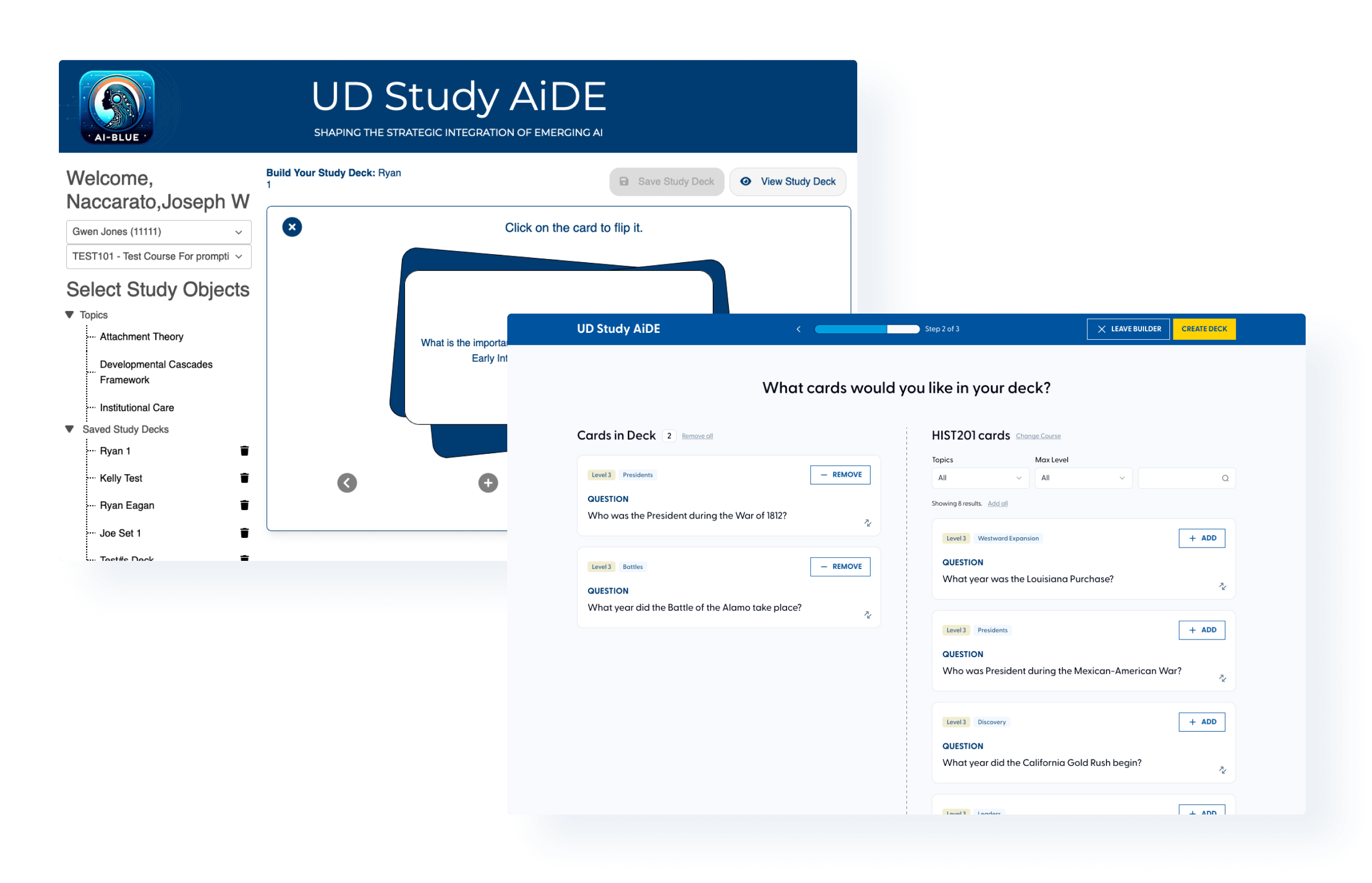
Before and after versions of the deck builder screen.
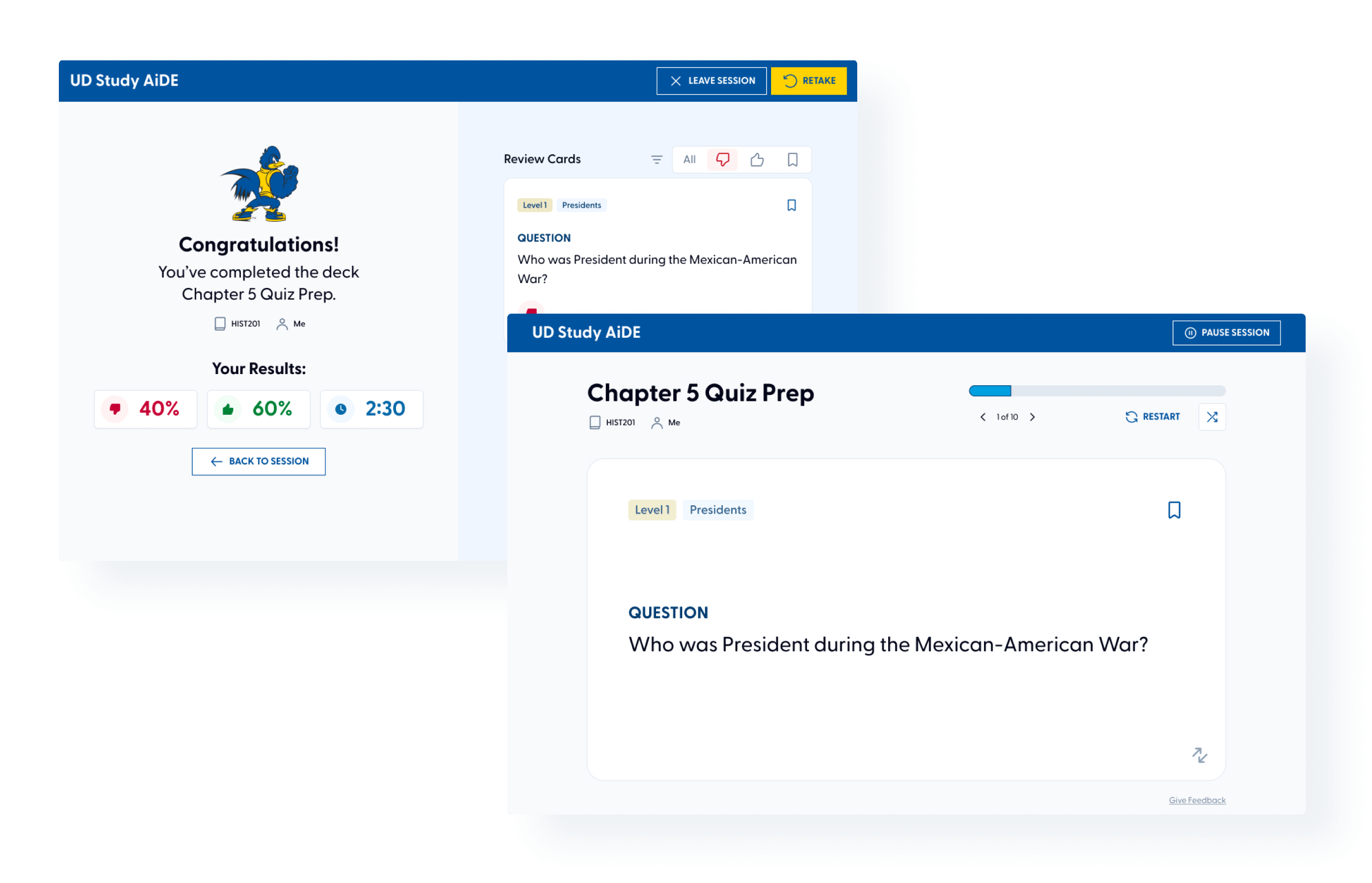
The new flashcard experience and results screen.
Results
The new Study AiDE frontend gave the University of Delaware a cohesive, branded experience ready for pilot testing and future expansion. The applications’s modular design provides a flexible structure for ongoing feature development, including additional learning experiences and faculty analytics. The new interface replaced a rough proof-of-concept with something that feels familiar, fast, and easy to navigate.
Students can now study more effectively using structured decks, while faculty are able to measure engagement and learning progress. More broadly, the project helped UD prove out an ethical, practical use of AI in education, setting the stage for continued experimentation in learning technology.
By working closely with UD’s Academic Technology Services team, Lincoln Loop delivered a customized, sustainable solution that balanced innovation with institutional responsibility, demonstrating what’s possible when technology and education work hand in hand.
A huge thank you to the Lincoln Loop team for bringing specialized design expertise to our project. We need to bolster our internal team to bring a new innovation to life and we couldn't have done it without you.
Let’s build something great
 Our work has helped over 1 billion people,
delivering solutions that make a difference.
![]() 15+ years of working together,
15+ years of working together,
expertise you can rely on
— no revolving doors.

5 STAR CLIENT REVIEWS
in the fields of friendliness, communication, and knowledge.